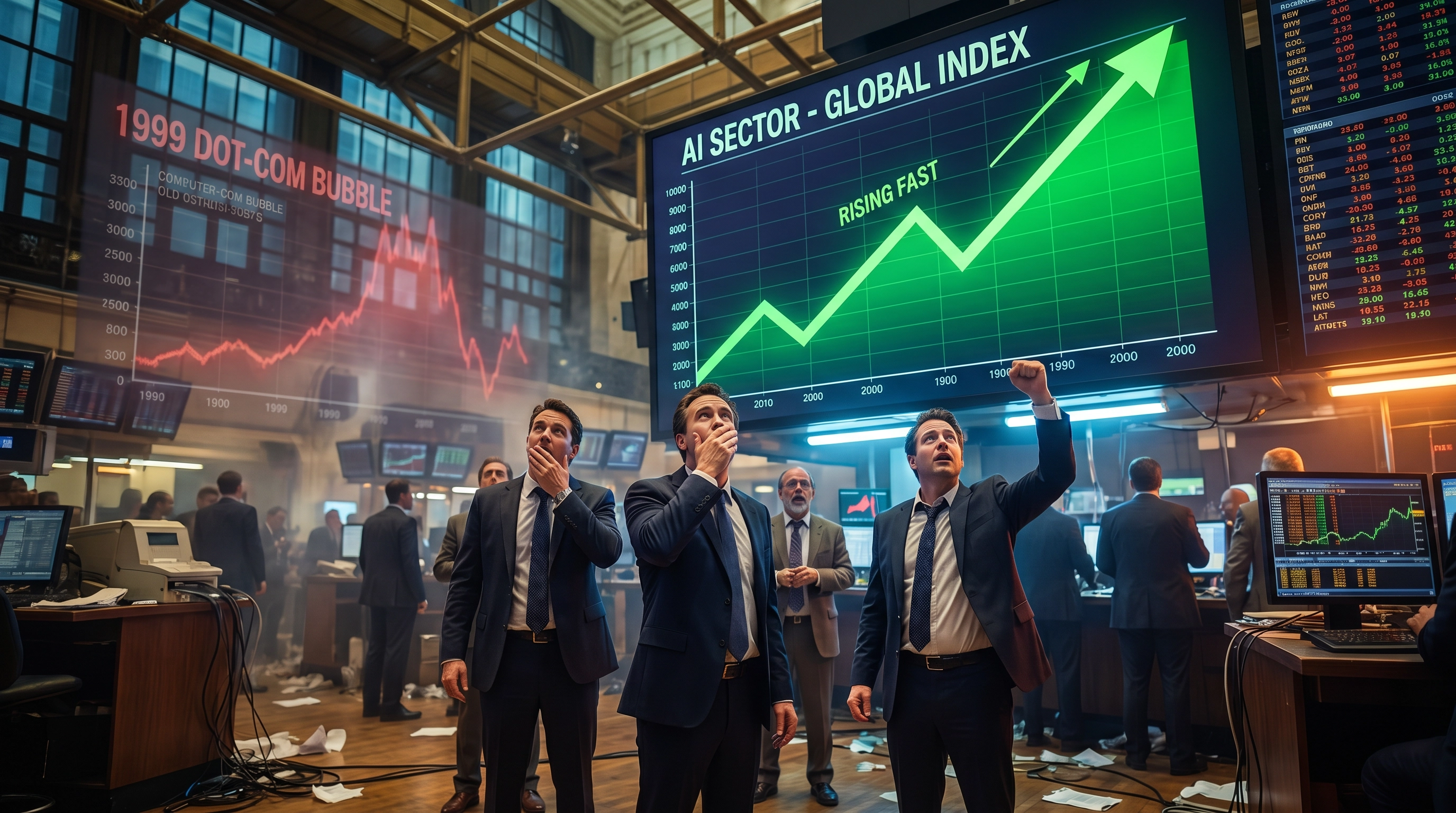
In the summer of 1999, the Nasdaq Composite was rising at a pace that made even its most enthusiastic supporters nervous. The index had already doubled from its 1997 lows. Valuations for internet companies were untethered from any conventional financial metric. And yet the market kept going up — not because investors had lost their minds, but because the momentum was self-reinforcing, the fear of missing out was overwhelming the fear of losing money, and the genuine transformative potential of the internet made it genuinely difficult to say with confidence that any particular valuation was too high.
The Nasdaq rose another 85% between July 1999 and its March 2000 peak. Then it fell 78% over the following two years, wiping out trillions in wealth and destroying hundreds of companies. The period from 1999 to 2000 is remembered as a cautionary tale about speculative excess. But it is also remembered as a period in which investors who got the timing right — who rode the melt-up and got out before the crash — made extraordinary returns.
BCA Research, one of the most respected independent investment research firms in the world, published a note this week arguing that the AI trade is entering a phase that looks uncomfortably similar to late 1999. The firm identified four specific indicators suggesting that the AI investment cycle is approaching its late stage — a phase that, historically, has been characterized by accelerating gains followed by a sharp correction.
Data Visualization
AI Trade Indicators vs. 1999 Dot-Com Benchmarks
- current
- dotcom_peak
The Four Warning Signs
The first indicator is AI adoption rates. The Ramp AI Index, which measures the percentage of US businesses paying for AI platform subscriptions, crossed 50% for the first time in March 2026. This is a significant threshold: it means that AI has moved from early-adopter territory into mainstream business adoption. In the dot-com analogy, this is roughly equivalent to the point in 1999 when internet adoption among US businesses crossed 50% — a milestone that preceded the final, most explosive phase of the bubble.
The second indicator is GPU and memory pricing. Rental rates for NVIDIA B200 GPUs averaged $5.09 per hour in March, up 13% from the prior month, and remain near their all-time highs. Memory spot prices have similarly remained elevated. High and rising compute prices suggest that demand for AI infrastructure is outpacing supply — a condition that historically precedes both continued investment acceleration and eventual oversupply corrections.
"We went into this year with the view that 2026 could end up being a lot like 2000. That thesis could still come to pass, but given the surge in demand for computers from AI agents, a 1999-type melt-up looks increasingly likely."
— BCA Research strategy team, April 2026
The third indicator is capital expenditure growth. Amazon, Google, Meta, and Microsoft are collectively projected to spend $587 billion on capital expenditures in 2026 — a figure that represents a staggering commitment to AI infrastructure. BCA notes that this level of spending creates its own momentum: companies that have committed to building AI infrastructure have strong incentives to generate returns on that investment, which drives further AI adoption, which drives further infrastructure spending. The risk, as BCA puts it, is 'not so much that AI will be a dud. Rather, chances are that we end up with an AI-empowered economy that does not require trillions of dollars of data center investments.'
The fourth indicator is financial risk metrics. Credit spreads for investment-grade technology debt have widened relative to the broader credit market — a sign that bond investors are pricing in greater risk in the technology sector even as equity investors remain euphoric. Financing inflows at hyperscalers have also exceeded outflows, partly because large tech companies are returning capital to shareholders through buybacks and dividends rather than reinvesting all cash flows. BCA describes this as 'the most worrying set of indicators.'
The Bull Case
The bull case for the AI trade rests on a simple argument: the technology is real, the productivity gains are real, and the economic value being created is real in a way that was not true of most dot-com companies in 1999. The Philadelphia Semiconductor Index is in the midst of its longest winning streak ever. Earnings growth expectations for S&P 500 companies have risen from 16% at the start of the year to nearly 20%, driven largely by AI-related productivity gains at technology companies. Investors returning to US stocks after the tariff-driven volatility of early 2026 are being pulled back by a combination of AI optimism and genuine earnings momentum.
BCA's base case is that the S&P 500 could reach 9,200 — a 30% gain from current levels — before the cycle turns. That would represent a significant further rally from already elevated valuations, but it is not implausible given the momentum in AI adoption and the earnings growth it is generating. The firm notes that the 1999 melt-up was not irrational in the sense that the internet really did transform the economy. The mistake was not believing in the technology; it was paying prices that assumed the transformation would happen faster and more profitably than it actually did.
The Bear Case
The bear case is more nuanced than a simple bubble narrative. The most sophisticated skeptics of the current AI trade are not arguing that AI is a fraud or that the technology will fail to deliver on its promises. They are arguing that the economic value created by AI will be distributed differently than current market prices imply — that the productivity gains will accrue to users and to the economy broadly rather than to the companies building AI infrastructure, that the competitive dynamics of the AI market will compress margins, and that the $587 billion in annual capex being committed to AI infrastructure will produce returns that are positive but not nearly sufficient to justify current valuations.
This is, in essence, the same argument that was made about the internet in 2000 — and it turned out to be correct in the medium term, even as it was wrong in the long term. The internet did transform the economy, but most of the companies that built the infrastructure for that transformation went bankrupt. The value accrued to the companies that used the infrastructure — Amazon, Google, Facebook — not to the companies that built it. The question for AI investors is whether the same dynamic will play out, and if so, which companies are the Amazons and Googles of the AI era rather than the Pets.coms and Webvans.
BCA's advice to investors is not to get out of the AI trade, but to be clear-eyed about what phase of the cycle they are in. Late-cycle rallies can be the most profitable phase of a bull market — but they are also the phase in which the risk-reward ratio deteriorates most rapidly. The investors who made the most money in 1999 were the ones who rode the melt-up with discipline and got out before the crash. The investors who lost the most were the ones who convinced themselves that the rules of financial gravity had been permanently suspended. The four indicators BCA is watching suggest that the AI trade is not yet at the point of maximum danger — but it is closer to that point than it was six months ago.