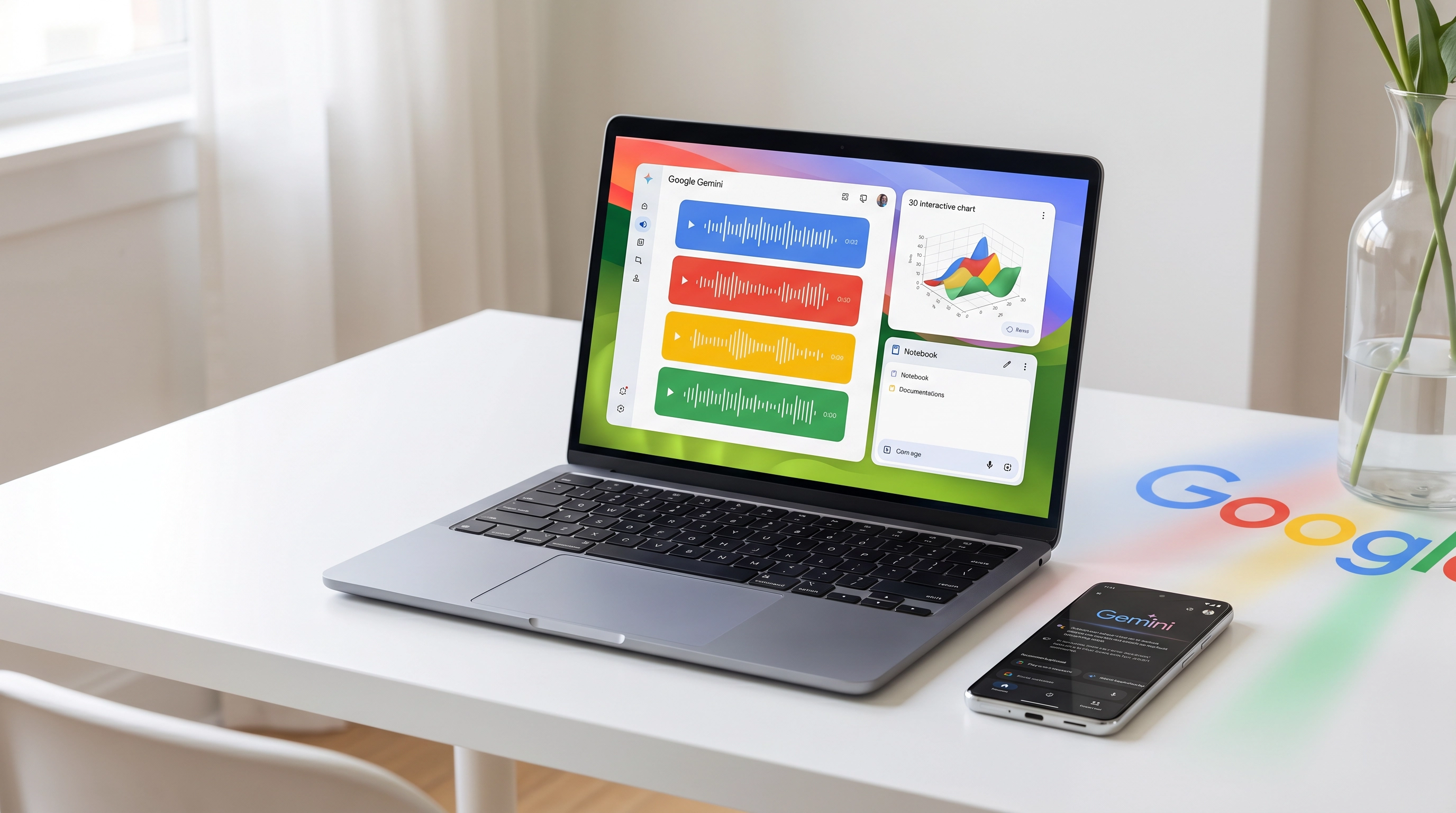
When Google launched its monthly Gemini Drops cadence a year ago, the updates felt incremental — new languages supported here, a new integration there. The 10th edition, released this week, is something different. Taken together, the April Drop's features describe a product that is no longer trying to be a better chatbot. It is trying to be the layer through which you interact with your entire digital life.
The headline feature is the native macOS app. Gemini is now available as a proper Mac application — accessible from the menu bar, the Dock, or a customizable keyboard shortcut, with the ability to share your screen for contextual assistance. This is not a web wrapper. It is a native application that integrates with macOS's accessibility and system APIs, allowing Gemini to see what you are working on and offer help without requiring you to switch contexts.
The Six Features of the April Drop
The native Mac app is the most visible addition, but the April Drop's other five features are arguably more significant in terms of what they reveal about Google's product strategy. Personal Intelligence, which connects Gemini to your Gmail, Google Calendar, Google Photos, and other Google services to provide personalized responses, is now going global after a US-only launch. The feature allows Gemini to answer questions like 'What did I agree to in my last email with the contractor?' or 'Find the photo from my trip to Tokyo where I was at the temple' — queries that require access to your personal data rather than the public web.
Notebooks, the second major feature, integrates NotebookLM directly into the Gemini app. NotebookLM, Google's AI-powered research tool that allows users to upload documents and ask questions about them, has been one of Google's most praised AI products since its launch. Bringing it into Gemini as a native feature — allowing users to organize their chats, research, and documents in a unified project workspace — is a significant step toward making Gemini a knowledge management tool rather than just a conversational assistant.
Music creation via Lyria 3 Pro is the most creatively ambitious addition. Users can now generate up to three-minute-long music tracks for free, with the ability to mix and customize high-fidelity audio. Lyria 3 Pro supports a range of genres and allows users to specify instrumentation, tempo, mood, and structure. The three-minute limit is meaningful — it is long enough for a complete song structure with verse, chorus, and bridge, making Lyria 3 Pro genuinely useful for content creators, game developers, and musicians exploring AI collaboration.
The fourth feature, 3D models and interactive charts, allows users to turn complex questions into interactive visual representations directly in the chat interface. Ask Gemini to explain the structure of a protein, and it can generate a rotatable 3D model. Ask it to visualize data, and it can produce an interactive chart that you can explore. This moves Gemini beyond text and static images into a richer, more spatially aware mode of explanation.
Finally, Nano Banana — Google's personal image generation feature — has been updated to use Personal Intelligence data. Users can now generate images that reflect their own life, interests, and visual style, drawing on their Google Photos history and personal preferences. The feature raises obvious privacy questions, but for users who have opted into Personal Intelligence, it represents a genuinely novel capability: AI-generated images that are personalized rather than generic.
"We're making your AI partner more integrated than ever. From native desktop support to music creation, Gemini is becoming the intelligent layer across everything you do."
— Google Gemini team, April Drop announcement, April 24, 2026
The Operating System Ambition
The pattern across these six features is consistent: Gemini is expanding from a question-answering tool into an ambient intelligence layer that connects your devices, your data, your creative work, and your communications. The native Mac app gives Gemini access to your desktop. Personal Intelligence gives it access to your email and calendar. Notebooks give it access to your research. Music creation and 3D visualization give it access to your creative output.
This is, in essence, the operating system play that Google has been building toward since the launch of the original Google Assistant. The difference is that the AI capabilities now available — the ability to understand context, generate content, and reason across large amounts of personal data — are qualitatively more powerful than anything that existed when Assistant launched in 2016. Google is betting that Gemini can become the interface through which users manage their entire digital lives, displacing not just other AI assistants but the operating system itself as the primary layer of human-computer interaction.
The Competition
Google is not alone in this ambition. Apple Intelligence, which Apple has been rolling out gradually since late 2024, pursues a similar strategy of integrating AI deeply into the operating system layer, with a strong emphasis on on-device processing and privacy. Microsoft's Copilot is embedded throughout Windows and Microsoft 365. OpenAI's desktop apps for macOS and Windows are attempting to establish ChatGPT as the default AI interface for computer users.
The difference is that Google has a uniquely powerful set of data assets — Gmail, Search, Maps, YouTube, Google Photos — that no competitor can replicate. Personal Intelligence is only as valuable as the data it can access, and Google's data advantage is substantial. Whether users are willing to grant Gemini access to that data, and whether Google can maintain their trust in doing so, is the central question for the product's long-term success.
The April Drop is the 10th in a monthly cadence that Google has maintained with unusual discipline. The pace of feature releases suggests a company that has found its product direction and is executing against it systematically. Whether Gemini ultimately achieves the operating system ambition or settles into a more modest role as a capable AI assistant remains to be seen. But the trajectory is clear, and the April Drop is the strongest evidence yet that Google is playing for something much larger than the chatbot market.